Intelligent Orchestration
The shift from human-routed coordination to system-composed decisions across value chains.
// what is intelligent orchestration?
I define Intelligent Orchestration as a major shift from human-routed coordination to system-composed decisions across value chains.
Let's look at history first. My personal take is that, for twenty-three centuries or more, hierarchy solved the coordination problem across every kind of operation. There was nothing to choose from - it was the only method available.
But wait, let me clarify first - you won't get another AI-in-supply-chain pitch from me; there are plenty in consulting decks, YouTube channels, and across the World Wide Web.
My message and thesis focus on a single structural shift that will shape our agendas over the next three to four years: the way we run and manage supply chains is changing. This change is fundamental; it's evolving fast and, in some areas, will be quite painful for all actors involved.
This quantum leap isn't happening because of new technology. The main reason is that the constraint that made hierarchy necessary is no longer binding.
I'm happy to debate this topic with other practitioners, as I don't pretend by any means that points of view that follow are any kind of absolute truth. And for any single individual, it's cognitively impossible to grasp each aspect of complex operating systems' drift triggered by substantial changes to their first principles.
But let's return to the point of history and my interpretation of events that brought us to the need to rethink issues of hierarchy, orchestration, and the future of operating models.
The 2,300-Year-Old Routing Problem
Before we started applying hierarchy as a management concept, it was a pure logistics problem.
To understand why, we must go back to the times of Alexander the Great. He became emperor of a newly formed region stretching from Greece to India. Importantly, he achieved this not through a new generation of weapons, but through intelligent application of supply chain management principles in their basic form.
Alexander the Great especially stands out for deploying the first structured approach to logistics, and you might recognise some of its forms that have lasted to our era.
It was achieved by pre-positioning supplies along campaign routes and consciously synchronising army marches with local area harvest cycles. Soldiers began using rivers and coastal shipping instead of overland carts, allowing them to disband baggage trains that significantly slowed movement, especially in unfriendly terrain.
As a result of such innovative thinking, an army of 40,000 soldiers moved at an unimaginable speed for the ancient world. I believe he was the first strategist to realise the war machine's constraint wasn't fighting. It was coordination.
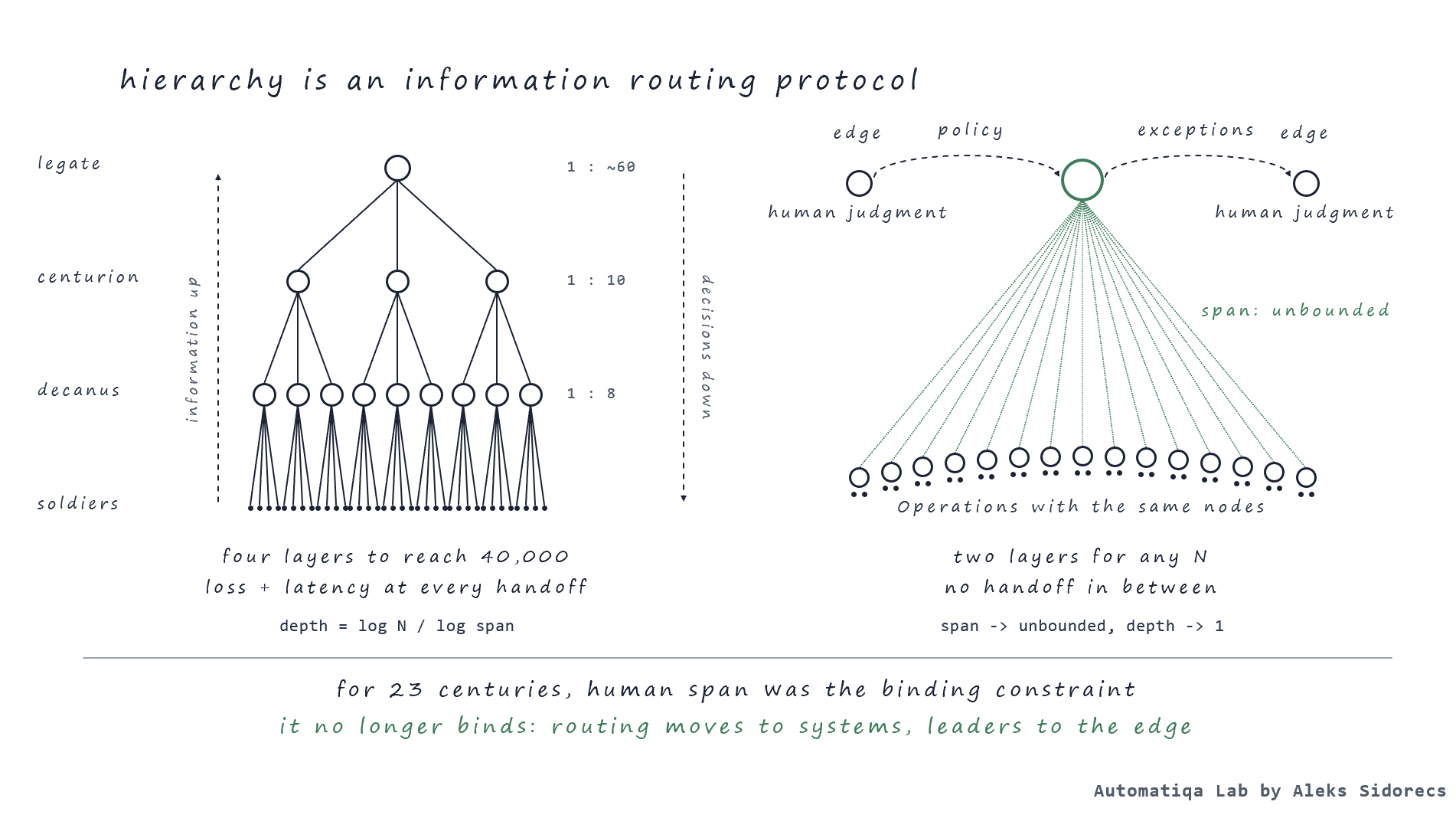
With supply lines stretching across 3,000 kilometres of hostile terrain, he solved a coordination equation in the only way possible: a multi-layered flow of human delegation and information exchange.
Regional governors supervised local supply of goods and consumables. The institute of quartermasters coordinated activities and alignment between provinces. A group of messengers connected army nodes.
Information flowed up, decisions flowed down. Every handoff lost fidelity, added latency, introduced interpretation.
The Romans formalised what Alexander had discovered. Eight soldiers sharing a tent needed a decanus. Eighty men needed a centurion. Five thousand needed a legate. The question was never whether you needed layers. The question was whether humans were the only option for what those layers do.
A foreman on a factory floor manages eight to fifteen workers. A shift supervisor manages three to four foremen. A plant manager manages the supervisors. The same routing protocol Alexander used to move grain across Persia - applied to moving products across a value chain.
This isn't a management philosophy. It's an information routing protocol. And for twenty-three centuries, humans were the only technology capable of running it.
MRP and the First Planning Layer
In 1806, the Prussian military lost to Napoleon and responded by inventing the General Staff - dedicated officers for planning, information processing, and coordination. Their explicit purpose: "to support incompetent Generals, providing talents otherwise wanting." They invented middle management before the term existed.
Operations had its own moment in the 1960s. Material Requirements Planning created a dedicated system for coordinating materials, production schedules, and procurement. For the first time, a machine held the plan - not a person with a clipboard. But the machine could not interpret or act. It computed; humans decided.
ERP as the Organisational Chart
In the 1840s, Daniel McCallum of the New York and Erie Railroad drew the first organisational chart to manage 500 miles of track and thousands of workers. West Point-trained officers brought military hierarchy into business. The "line versus staff" distinction became corporate vocabulary.
ERP did the same for the enterprise. SAP, Oracle, JDA made the information structure visible and traversable. You could see inventory in Hamburg from a desk in Singapore. You could track a purchase order from requisition to receipt.
But visibility isn't intelligence. Seeing the supply chain isn't the same as orchestrating it. An ERP is a map. It doesn't drive.
Lean and Six Sigma - Optimising the Routing Layer
Frederick Taylor broke work into specialised tasks, assigned experts, and measured everything. Efficiency through decomposition. Lean and Six Sigma applied the same logic to operations - waste reduction, process control, standardisation, continuous improvement.
Powerful within a stable operating model. Brittle when the world changes. A supply chain optimised for efficiency assumes the environment stays still long enough for the optimisation to pay off. Since 2020, it hasn't.
The human routing layer is faster and leaner, but it's still human.
The Control Tower - Operations Gets Its Matrix
In 1959, McKinsey consultants Gilbert Clee and Alfred di Scipio published the matrix organisation - combining functional specialties with divisional units. Central standards plus local agility. Shell and GE adopted it. It became the "modern" corporation.
Supply chain built its own matrix: the control tower. Demand, supply, logistics, finance - all visible in one room or one screen. Cross-functional, real-time (or near enough), integrated. AI assists, humans validate and approve. APIs connect systems. Anomalies surface before failure.
Better than silos. But still human-routed. The control tower sees everything. It decides nothing autonomously. Every escalation still flows through a person. Every exception waits for a meeting.
The Digital Twin as World Model
Every layer of hierarchy exists because someone, somewhere, needs to ask "what is happening?" and relay the answer to someone who needs to decide. What if the operation itself could answer - continuously, without being asked?
The digital twin isn't a 3D visualisation. It's a decision substrate. A real-time, machine-readable representation of inventory positions, production capacity, demand signals, supplier state, logistics networks, working capital constraints. It replaces information flow through management layers. The twin knows what the control tower operator had to ask about. It doesn't wait to be queried.
A network of specialised agents coordinates across functions without centralised direction. AI-driven within policy guardrails. Humans handle exceptions. The system anticipates and routes around disruption before the S&OP meeting convenes.
The Intelligence Layer - Composing Decisions
This is where intelligent orchestration begins.
The intelligence layer doesn't just observe - it composes. It takes existing capabilities across the value chain and assembles them into responses that no individual planner would have constructed.
A demand signal shifts in Southeast Asia. The intelligence layer recognises the downstream impact on European production three weeks out. It composes a procurement rebalance across two alternative suppliers, a logistics reroute through Rotterdam instead of Antwerp (where port congestion is building), and a working capital adjustment to cover the expedited shipment - all before the weekly planning call.
No supply chain planner decided to trigger that response. The capabilities existed. The intelligence layer recognised the moment and composed them. This is the difference between a system that alerts and a system that acts.
Continuous self-optimisation. Closed-loop execution where action feeds learning and learning refines action. Demand sensing with real-time model retraining. Autonomous contract negotiation within policy bounds. Self-adjusting safety stock across a thousand SKUs.
The Edge - What Stays Human
The edge is the boundary where the intelligence system meets human judgment. Places the model can't reach: intuition, cultural context, trust dynamics, ethical decisions, novel situations, high-stakes calls where the cost of being wrong is existential.
In operations, the edge is where value chain leadership actually matters:
- Supplier relationships - a twenty-year partnership with a grower in Colombia can't be reduced to a risk score
- Crisis judgment - when the Suez is blocked, the model proposes alternatives but a human decides which customers get priority
- Ethical sourcing - the cheapest route isn't always the right route
- Market entry decisions - entering a new geography is a bet, not a calculation
- Talent and culture - building teams that can operate this way requires leadership, not algorithms
"A world model that cannot touch the world is just a database."
Intelligent orchestration doesn't eliminate leadership. It repositions it. Leaders move from the routing layer - where they spent most of their time relaying information, aligning functions, and arbitrating priorities - to the edge, where they do work that only humans can do.
What This Is About
Intelligent orchestration isn't a product. It isn't a platform. It's the recognition that the coordination layer in physical operations - the layer that has been human for twenty-three centuries - is moving to systems. And that this changes everything: how we organise teams, how we make decisions, how we build technology, and where leaders spend their time.
This is what we explore:
The hierarchy served us well. It's time to move to the edge.
Frequently Asked Questions
What is intelligent orchestration?
Intelligent orchestration is the shift from human-routed coordination to system-composed decisions across value chains. It uses AI agents, digital twins, and real-time data to move the coordination function - traditionally performed by managers, planners, and meetings - into intelligent systems that compose decisions proactively.
How is intelligent orchestration different from automation?
Automation executes predefined tasks faster. Intelligent orchestration composes decisions across functions in response to real-time signals. Automation follows a script. Orchestration writes the script in the moment, drawing on capabilities across the value chain.